

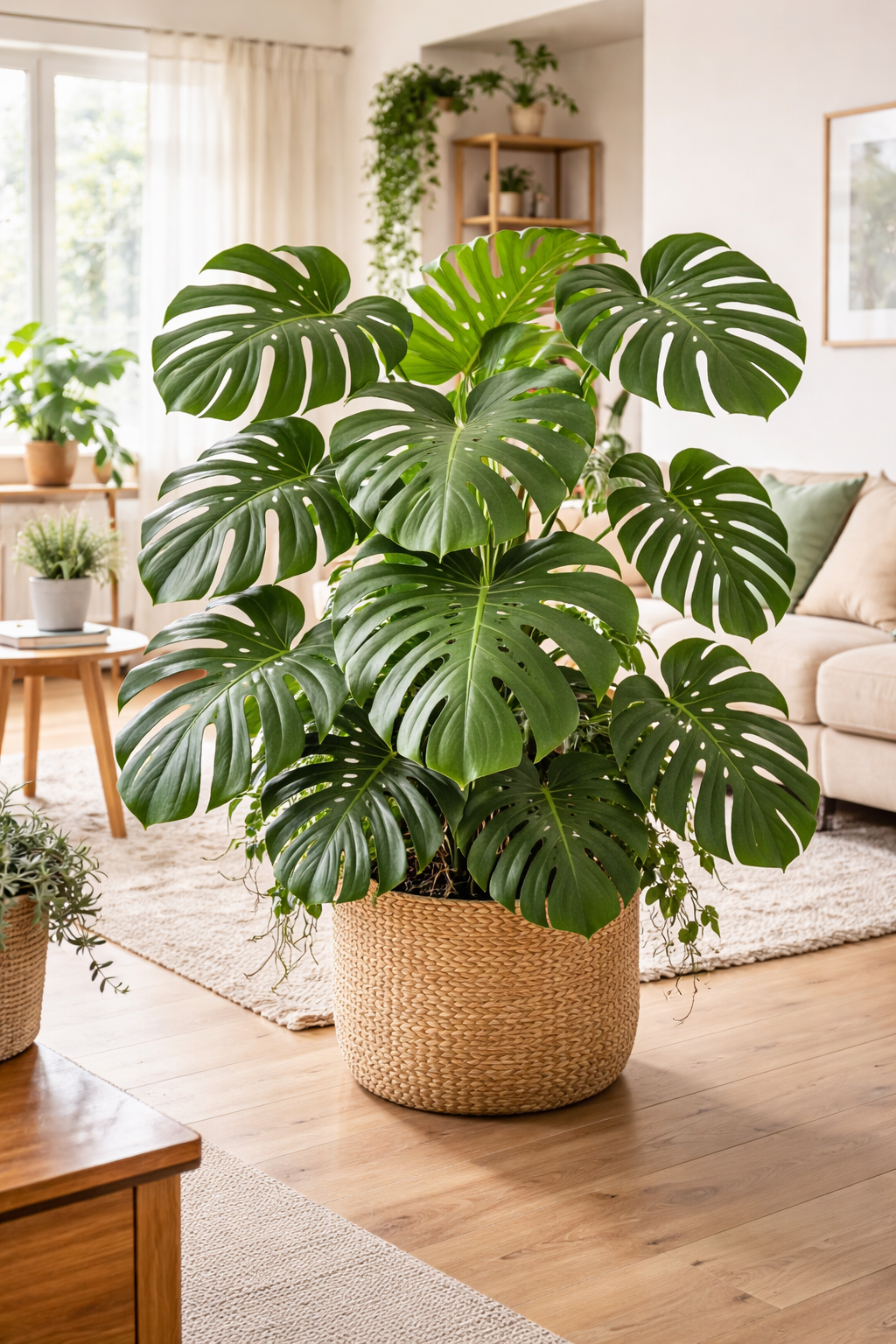
Large, statement-making houseplants can transform a room without any renovation: they soften lines, absorb noise, improve visual comfort and—if you choose wisely—are easy to keep. The secret isn’t “what’s trendy” but your real light, ambient humidity, and the space available for pot and canopy. Before buying, I suggest a quick light audit (watch shadows, hours of brightness, and whether there’s direct sun) and a weekly watering routine. If you’d rather have it checked on-site and get combinations that work from day one, book an in-home consultation with our team at Jardinería Óscar H..
How to choose fast (without overthinking)
If your living room gets bright, indirect light, go for broad-leaf statement plants. Monstera deliciosa shines with moss poles; Ficus lyrata brings sculptural height; Strelitzia nicolai (giant bird of paradise) loves a bright corner without harsh sun; Philodendron bipinnatifidum creates a lush, tropical mass; Pachira aquatica tolerates stable interiors; Ficus elastica (rubber plant) offers deep greens or variegation; Kentia (Howea forsteriana) and Areca deliver a palm vibe without drama; Spathiphyllum ‘Sensation’ rewards you with huge leaves and blooms if humidity cooperates. For medium light, Dracaena fragrans and Dracaena marginata are workhorses, Schefflera arboricola grows as a compact tree, and Fatsia japonica handles cooler interiors. If you have low light (hallways, entryways), pick tolerant species: XL Sansevieria is famously forgiving, large Zamioculcas copes with neglect, Aspidistra elatior is nearly indestructible, and Chamaedorea elegans gets by with little. In warm spaces with good light and some moisture, Alocasia macrorrhizos, Dieffenbachia seguine, Calathea orbifolia, and Codiaeum variegatum (croton) thrive if you avoid drafts. For sunny, dry corners, Yucca elephantipes, Beaucarnea recurvata (ponytail palm), and tall columnar cacti or Euphorbia trigona bring presence with spaced-out watering. Special mentions: Musa ‘Dwarf Cavendish’ brings a jungle look if humidity is high, Ficus binnendijkii ‘Alii’ is more interior-tolerant than other ficus, and Caryota mitis (fishtail palm) elegantly fills bright corners. With these 25, you can dress almost any room.
Water, humidity, and potting mix: the 80% that mattersRiego, humedad y sustrato: el 80% del éxito
Big plants fail more often from overwatering than underwatering. Think in cycles: water thoroughly, then let the mix dry according to species and season. For tropicals (monstera, philodendron, strelitzia), use an airy blend with coco fiber, bark, and perlite so roots can breathe. For palms (kentia, areca) and dracaenas, a universal mix improved with perlite resists compaction. Heating dries the air and scorches leaf tips: place pebble trays with water under the grow pot (without touching the base), group plants to create microclimates, or run a humidifier at critical hours. If you don’t want to juggle mixes, calendars, and measurements, we’ll set up your watering and humidity plan in a single visit: Jardinería Óscar H..
Repotting, planters, and support
Large specimens don’t move often: repot every 18–24 months, ideally early spring, stepping up one pot size and renewing a third of the medium. For heavy branches (ficus lyrata, giant monstera), install stakes or moss poles to direct growth and prevent tipping. Decorative cachepots without drainage are perfect if you keep the nursery pot inside and watch runoff after each watering. If your plant arrives rootbound from the nursery or you’d like to divide it, we handle repotting and setup for you, with establishment guaranteed: Jardinería Óscar H..
Common indoor pests and how to control themPlagas domésticas y cómo controlarlas
Indoors you’ll mostly battle mealybugs, spider mites, and thrips. Prevention is proper light, balanced watering, and clean foliage. At first signs, isolate the plant, shower the leaves to dislodge adults, and use potassium soap or horticultural oil depending on species. If the outbreak returns or the canopies are very large, a monthly integrated control plan breaks the cycle without ruining looks. We offer diagnosis, treatment, and follow-ups so it doesn’t come back: Jardinería Óscar H..
Typical mistakes and quick fixes
Lower leaves yellowing usually means too much water and low oxygen around roots: space out waterings and aerate the mix. Crispy edges hint at low humidity or hot drafts; relocate and humidify. Droopy ficus after moving equals relocation stress: stability and consistent light fix it. Pale patches on strelitzia and monstera point to direct sun; filter with sheer curtains. If growth stalls, it may be time for light feeding in season and a slightly larger pot. If diagnosing feels overwhelming, we’ll do it for you and hand you a personalized care sheet: Jardinería Óscar H..
Three real-world scenarios to get it right
In a north-facing living room with heating, lean on XXL zamioculcas, tall sansevierias, aspidistra, and dracaenas, plus a discreet humidifier. In a very bright, dry penthouse, yucca, beaucarnea, and euphorbia/cacti columns shine with sparse watering and a more mineral mix. In a bright loft without direct sun, monstera, strelitzia, ficus elastica, and philodendron create a stunning green landscape if you keep moderate humidity and add support.
DIY or delegate?
You can absolutely build and maintain a “mini indoor jungle”, but it takes consistency: measured watering, leaf cleaning, pest watch, and timely repotting. If you prefer to enjoy the look without the technical hassle, we can handle selection, delivery, repotting, watering, and monthly maintenance, with scheduled visits and a status check. Start with a no-obligation assessment at Jardinería Óscar H..